
The Herbal Bath: Crafting Soothing "Tea Bags" for Dry Skin and Sore Muscles
Imagine sinking into a warm bath, not just with bubbles, but with the gentle aroma of herbs known for their healing properties. Herbal baths are a time-honored tradition, offering a simple yet profound way to deliver botanical goodness directly to your skin and muscles. This isn't just about relaxation; it's about harnessing the power of nature to soothe, hydrate, and restore.
Why Choose an Herbal Bath?
The benefits of an herbal bath extend beyond mere indulgence:
-
For Dry Skin: Many herbs are naturally emollient, hydrating, and anti-inflammatory. When steeped in warm water, they release compounds that can calm irritated skin, reduce redness, and impart moisture, leaving your skin feeling softer and more supple.
-
For Sore Muscles: Certain herbs possess analgesic and anti-inflammatory properties that can penetrate the skin to help alleviate muscle tension, stiffness, and pain. The warmth of the bath itself, combined with these botanicals, promotes circulation and deep relaxation, aiding in muscle recovery.
-
Aromatherapy Benefits: Beyond the physical, the aromatic compounds released by the herbs can have a profound effect on your mood. Lavender, for instance, is renowned for its calming effects, while peppermint can be invigorating. This holistic approach nourishes both body and mind.
Crafting Your Herbal "Tea Bags"
Making your own herbal bath "tea bags" is incredibly simple and allows for complete customization based on your needs.
What You'll Need:
-
Dried Herbs: Choose high-quality, organic dried herbs. (Suggestions below!)
-
Small Muslin Bags, Organza Bags, or even a Clean Sock/Cheesecloth: These act as your "tea bags" to contain the herbs.
-
Twine or String (Optional): If using cheesecloth or a sock, you'll need this to tie it off.
Suggested Herbs for Specific Benefits:
-
For Dry/Irritated Skin:
-
Oats (Colloidal Oatmeal): Exceptionally soothing and moisturizing, perfect for itchy or dry skin.
-
Calendula Flowers: Anti-inflammatory and healing, great for sensitive skin.
-
Chamomile Flowers: Calming, anti-inflammatory, and gentle.
-
Lavender Flowers: Soothing, aromatic, and mildly antiseptic.
-
-
For Sore Muscles:
-
Epsom Salts (not an herb, but a fantastic addition!): Rich in magnesium, which helps relax muscles and reduce soreness. Add directly to the bathwater.
-
Peppermint Leaves: Invigorating and can help relieve muscle aches.
-
Rosemary Leaves: Stimulating and can improve circulation to sore areas.
-
Ginger Root (dried slices): Warming and can help with muscle pain and stiffness.
-
How to Make & Use Your Bath Tea Bag:
-
Select Your Herbs: Choose 1-3 tablespoons of a single herb or a blend of herbs for each bath "tea bag." For example, a mix of oats, calendula, and lavender for dry skin, or rosemary and peppermint for sore muscles.
-
Fill the Bag: Place your chosen dried herbs into a muslin bag, organza bag, or the center of a piece of cheesecloth/clean sock.
-
Tie it Off: Securely tie the top of the bag or cheesecloth with twine, ensuring the herbs won't escape into the bathwater.
-
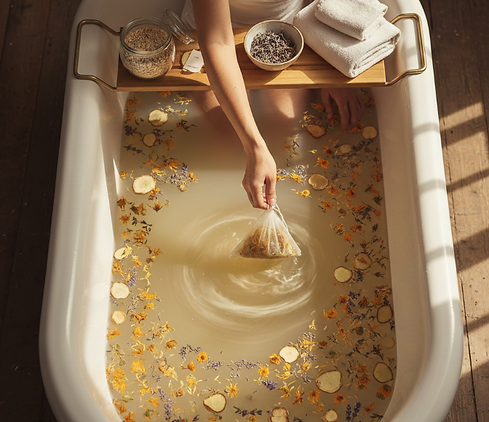
Steep in the Tub: As your bathwater fills, toss your herbal "tea bag" directly into the tub. Allow it to float and steep as the tub fills. You can also hang it under the faucet, letting the running water flow through the bag for a stronger infusion.
-
Enjoy Your Soak: Get in and relax for 15-30 minutes, allowing the herbal infusion to work its magic on your skin and muscles. You can gently squeeze the bag occasionally to release more of the herbal goodness.
-
After the Bath: Discard the herbs (compost them if possible!). Rinse your tub, as some herbal residue might be left behind.
A Natural Ritual for Wellness
Integrating herbal baths into your self-care routine is a delightful way to connect with nature's healing power. Whether you're seeking relief for dry, itchy skin, easing tired, aching muscles, or simply yearning for a moment of fragrant tranquility, these simple herbal "tea bags" offer a potent, natural solution.
Reference
Chen, B., Zhan, H., Chung, M., Lin, X., Zhang, M., Pang, J., & Wang, C. (2015). Chinese herbal bath therapy for the treatment of knee osteoarthritis: Meta-analysis of randomized controlled trials. Evidence-Based Complementary and Alternative Medicine, 2015, 1–12. https://doi.org/10.1155/2015/949172 Kim, H.-S., Hwang, H.-J., Seo, W.-D., & Do, S.-H. (2023). Oat (Avena sativa L.) sprouts restore skin barrier function by modulating the expression of the epidermal differentiation complex in models of skin irritation. International Journal of Molecular Sciences, 24(24), 17274. https://doi.org/10.3390/ijms242417274 Koulivand, P. H., Khaleghi Ghadiri, M., & Gorji, A. (2013). Lavender and the nervous system. Evidence-Based Complementary and Alternative Medicine, 2013, 1–10. https://doi.org/10.1155/2013/681304 Lakhan, S. E., Sheafer, H., & Tepper, D. (2016). The effectiveness of aromatherapy in reducing pain: A systematic review and meta-analysis. Pain Research and Treatment, 2016, 1–13. https://doi.org/10.1155/2016/8158693 Shenefelt, P. D. (2011). Herbal treatment for dermatologic disorders. In Oxidative Stress and Disease (pp. 383–403). CRC Press. https://doi.org/10.1201/b10787-19 Wangchuk, P., Yeshi, K., Ugyen, K., Dorji, J., Wangdi, K., Samten, & Tshering, P. (2020). Water-based therapies of Bhutan: Current practices and the recorded clinical evidence of balneotherapy. Water, 13(1), 9. https://doi.org/10.3390/w13010009
The information provided on this website is for educational purposes only and cannot substitute for professional medical advice, diagnosis, or treatment. Always seek the advice of your physician or other qualified healthcare provider with any questions you may have regarding a medical condition. Never disregard professional medical advice or delay in seeking it because of something you have read on this website.